11/05/26 - Grass Routes

Updated: May 13
30th April 2026
Research Exchange: Grass Routes MA Conference
Last month, my colleague Alyson asked for my support in working with the Masters students at our place of work, the Northern School of Art. Alyson and I, both lecturers and PhD students have developed a really supportive working relationship, often throwing ideas back and forth around practice-based research. It has been invaluable to have someone at a similar stage in the PhD process to discuss challenges, developments, and ways of thinking through research. As part of these conversations, Alyson shared what the MA students had been working on and felt that my research would make a valuable contribution to the Spring conference they had organised.
The conference itself, Grass Routes, was a student-led research event that invited guest speakers and MA students to present papers exploring tacit practices and intangible heritage. The conference explored links between preserving communities and identities through local arts and cultural ecologies, with themes centred around storytelling, collective memory, sensory experience, and the preservation of knowledge that is often difficult to document or hold onto. There was a particular emphasis on the handing down of ephemeral community knowledge, the subtle ways of knowing, remembering, and experiencing place that can easily be overlooked.
Taking part in the conference felt like a natural extension of my research. Reflecting afterwards, I realised how closely my own work aligns with these ideas, despite approaching them through walking, landscape, and soil. My PhD research is grounded in slow and attentive walking through the landscapes of northern England and southern Scotland, where understanding emerges through direct and repeated encounters with place. Walking becomes both a method and a form of listening, allowing subtle feelings and sensations to surface over time. Many of these experiences are fleeting and, although documented through blogs such as this, can often be difficult to fully explain. In many ways, these encounters feel connected to forms of intangible heritage, ways of knowing and relating to landscape that exist beyond formal records, instead carried through experience, memory, and embodied engagement.
The conference also encouraged conversations around how intangible experiences might be recorded or preserved. This resonated strongly with my practice, where photography, installation, soil sampling, earth batteries, and field recordings become methods for documenting things that are often invisible or temporary. Rather than simply recording landscape, the work attempts to remain attentive to what exists beneath and beyond immediate perception, considering how soil itself might hold traces of memory, movement, and unseen energies. Presenting my research within this context opened up an interesting space to think about how landscape, sensation, and speculative forms of knowledge might contribute to wider conversations surrounding heritage and belonging.
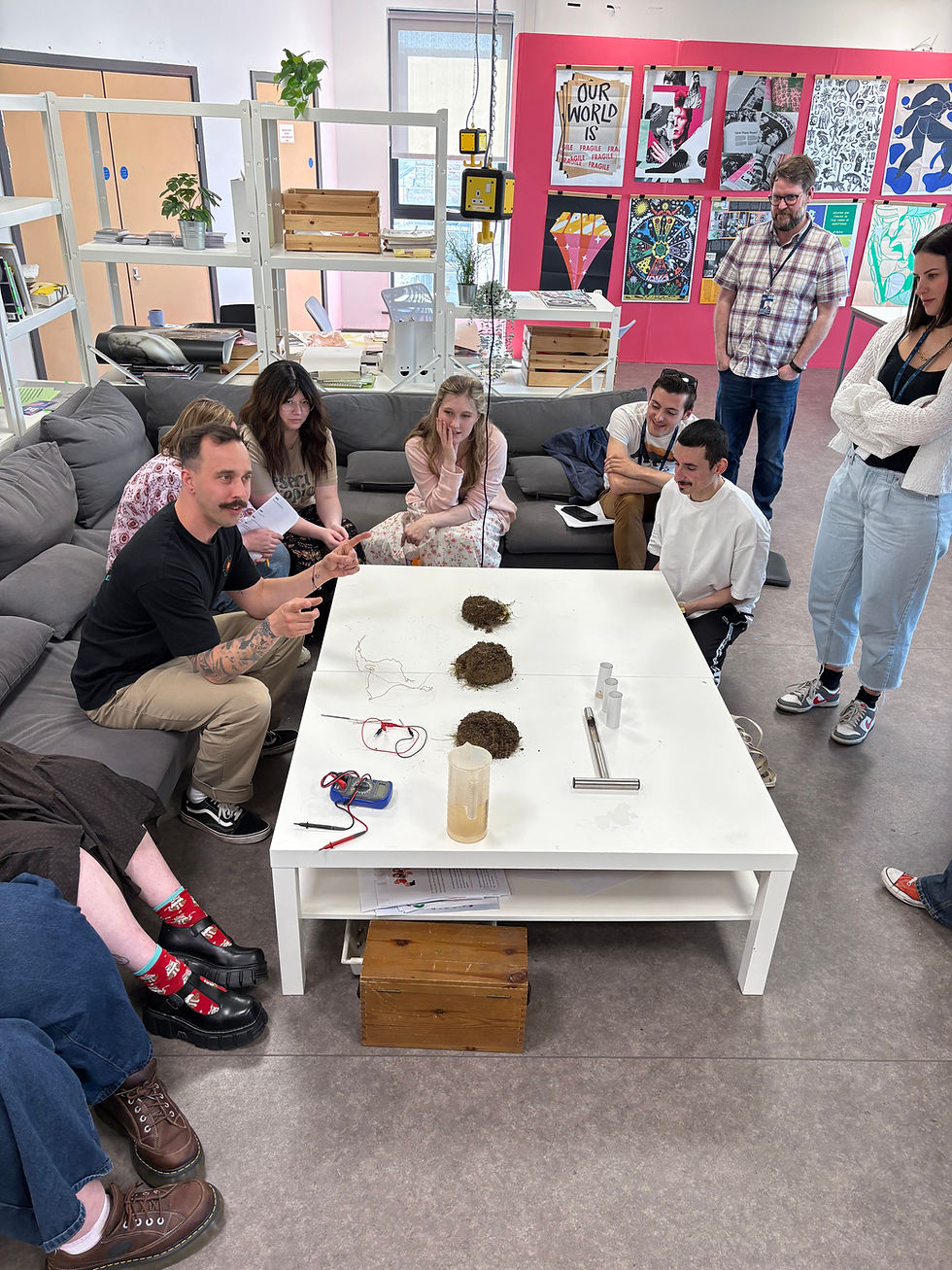
I approached the conference with a relaxed style of delivery. I wanted to lean into the idea of tacit learning, demonstrating the importance of embodied knowledge and practice-based understanding, so I brought along an earth battery. I say brought along, in reality, I unearthed three samples of soil from the grass verge in the car park twenty minutes before I was due to speak to use as both an energy source and an example of locality.
Before beginning the presentation itself, I addressed the audience with my intentions, welcoming conversation not just at the end but throughout. Breaking away from the usual expectations of conference presentations felt refreshing and, I hope, refreshing for the audience too, many of whom were students. I wanted to remove any sense of separation between presenter and audience, blurring that academic boundary and creating something more conversational.
Once introductions were complete, I invited everyone to stand up and gather around the table where the soil samples had been laid out. Sitting together around the soil, I discussed how these were the very materials I connect with, embody, and work alongside in my research. I spoke about the ethics of unearthing, as small insects slowly emerged from the soil and crawled across the table, and I explained how everything would later be returned to its place of origin.
From there, I demonstrated how an earth battery is created and discussed what occurs between the inserted materials and the soil itself. The audience became genuinely interested in the live energy flowing through the cells and the changing readings on the meter. At one point, I asked an audience member to pour water onto the soil, and immediately the reading increased. This became an important moment of discussion, not simply about reaction and conductivity, but about evidencing the hidden systems alive within soil. More importantly, it became a way of demonstrating how embodied and durational relationships with landscape can reveal experiences and energies that often remain unseen. This point in the exchange of knowledge allowed for me to position my audience within the practice, they were able to engage locally and with a micro environment intertwined on a regular basis. It was here also that I discussed about the vitality of soil, and the reciprocal care we could give to soil, when feeding it electrolytes (water), which saw the increase of energetic output.
Following the demonstration, we returned to the presentation screen and continued the discussion around my wider research. Questions emerged around spirituality, ethics, boundaries, and freedom of movement, all of which challenged me in thoughtful and unexpected ways. While I often come across confidently when presenting, there are always moments where particular questions can place you on the spot. Still, I try to respond openly and honestly, and from the feedback I received afterwards, it seemed those conversations were genuinely valued.
My intention throughout the presentation and Q&A was to offer a clear and distinctive contribution to the conference theme. What became increasingly apparent throughout the day was the socio-cultural phenomenon occurring between the conference themes and its participants; a shared space where local knowledge, storytelling, embodied experiences, and different ways of knowing were collectively exchanged through creative practice. In many ways, the conference itself became an example of intangible heritage in action, where conversations, experiences, and perspectives were temporarily gathered, shared, and carried forward.
Finally, I want to thank Alyson, Jenny, and Claire for taking the time to consider my research and for giving me the opportunity to share it with conference attendees. It was a genuinely rewarding experience and one that left me reflecting on how research can be shared in ways that feel open, conversational, and embodied.


Comments