14/05/2026 - Resilience Exhibition

12th April – 1st May
Visual Exchange: Resilience Exhibition

Last month, I mentioned that one of my aims moving into the final year of the PhD was to disseminate my practice more widely, not only within research areas closely aligned to my own interests in landscape and soil, but also through exhibition contexts where visual conversations can take place through exchange and interpretation. It was therefore great to have my proposal accepted for the Resilience exhibition at Hartlepool Art Gallery.
Of course, there is always a question that needs answering when submitting exhibition proposals: where does the work fit? Over the years, I have found it increasingly difficult to identify suitable group exhibitions that genuinely connect with my research and practice. There seems to be a recurring series of themes within many exhibition open calls, and while I will avoid getting into the politics of that too much, I do think some themes unintentionally narrow opportunities for practitioners working outside those conversations. Small rant over. So why did Resilience appeal to me?
Firstly, Hartlepool Art Gallery sits directly across the road from my place of work. It has close connections with the Northern School of Art and consistently supports students through opportunities to disseminate their work, while also welcoming them to experience the work of practising artists. Whether local, national, or international, exhibitions at the gallery often introduce new artistic perspectives and ways of thinking. There is an important social and cultural exchange taking place, creating opportunities for new entanglements of creativity and dialogue.
The theme of Resilience immediately resonated with me. When I think about resilience, I think about strength, durability, longevity, and endurance. I think about persistence through challenge. In many ways, these ideas sit closely alongside my own practice. My durational walks often explore the aesthetic qualities of landscape, but there is also hardship and endurance embedded within them. Walking across remote terrains and difficult weather conditions asks something of the body. Those familiar with my research blog may remember my walk up the Merrick, one of the most physically demanding and challenging walks I have undertaken.
Yet resilience within my practice is not only about the act of walking itself. Removing the human from consideration for a moment, I begin to think about the material underfoot: soil. Soil is deeply resilient. It endures thousands of years of natural and human induced pressures while continuing to sustain unseen ecological systems. It withstands shifting atmospheric conditions, contamination, changing climates, biochemical reactions, microbial activity, insects, and decay. Although increasingly vulnerable and depleted, soil remains an incredibly hardy and adaptive material.
The work (now titled Movements Underfoot), engages with resilience through the living ecology of soil, a material often perceived as inert yet persistently regenerative. Within the post-industrial context of Hartlepool, the work foregrounds soil’s capacity to endure pressure, contamination, and neglect while continuing to sustain unseen microbial life. Including soil gathered from the local landscape felt particularly important, creating an intersection between the wider landscapes explored throughout my research and a more specific sense of locality that resonated strongly with the exhibition theme. Hartlepool itself is rich with industrial histories that have unfolded across centuries, dramatically shaping and reshaping the surrounding landscape. To think about what exists beneath our feet and frame it through resilience felt like an exciting opportunity.
To strengthen the proposal further, I discussed the use of expired photographic paper as a material that itself embodies resilience. Materials often considered obsolete can be reactivated through light and soil contact, revealing latent chemical and ecological energies. Expired photographic paper is frequently discarded, forgotten in attics, cupboards, or storage rooms, but I have always relished the opportunity to work with it. In some ways, the box of paper takes on agency. Designed to react with light and produce visual narratives within a fixed lifespan, it carries an expiry date that suggests limitation. Yet I know from experience that the material can continue beyond these imposed parameters. It becomes resilient, finding renewed purpose through process, connecting materially and conceptually with resilient soil.
Through slow walking, attentive gathering of unearthed soil, and applied lumen processes, the installation becomes a meditation on resilience as quiet persistence, a network of micro transformations unfolding slowly across surfaces and gradually revealing themselves visually. The final lumen print comprises eighteen individual 8 × 10 inch sheets of expired photographic paper. Each sheet functions as both surface and site, exposed through direct contact with soil and environmental conditions while evidencing my movement through North Gare in Hartlepool. Installed collectively, the work occupies an overall spatial arrangement of approximately 830 mm × 1350 mm.
The making process itself involved durational walking and the careful unearthing of soil, engaging with and embodying the landscape before returning materials to the studio. Once gathered, the soil was prepared and applied to light sensitive photographic surfaces, allowing me to draw movement across the expired paper. Development then took around a week, although my Bernese, Molly, decided to walk across the work at one point, adding an unplanned intervention. Once completed, each piece was scanned through my Epson at 600dpi, enabling strong clarity and texture to emerge. After all eighteen images had been scanned, I adjusted colour temperatures across the prints, attempting to draw out subtle soil conditions. While lumen prints do not reveal detail in the same way as soil chromatography, shifts in colour can still suggest proteins, matter, and nutrients. These colour adjustments became a way of visually communicating resilient qualities within the soil, offering a visual voice to the hidden systems underfoot. After a successful push of colour, each photographic print was reprinted on matt 8x10 paper.

When installed within the gallery, the work looks great and I am really pleased with the curatorial direction taken during hanging. I had initially been torn between a vertical or horizontal arrangement and eventually decided to trust the curatorial team’s instinct. They opted for a vertical configuration, which, if I am honest, was probably the right decision and seemed to capture something of a northern coastal movement. What also surprised me was the wall colour. A rich navy blue sat behind the work rather than the clinical white gallery wall I had expected. I ended up really liking this decision. The deep colour allowed a visual richness to move between each photographic surface, creating a stronger aesthetic relationship between the works.

Another important consideration was the hanging method. I specifically requested that bulldog clips were not used. It felt important that no visible hanging mechanism interrupted the line and flow of movement across the work. I wanted audiences to move visually through the soil traces uninterrupted, allowing their gaze to travel across the surface without distraction.
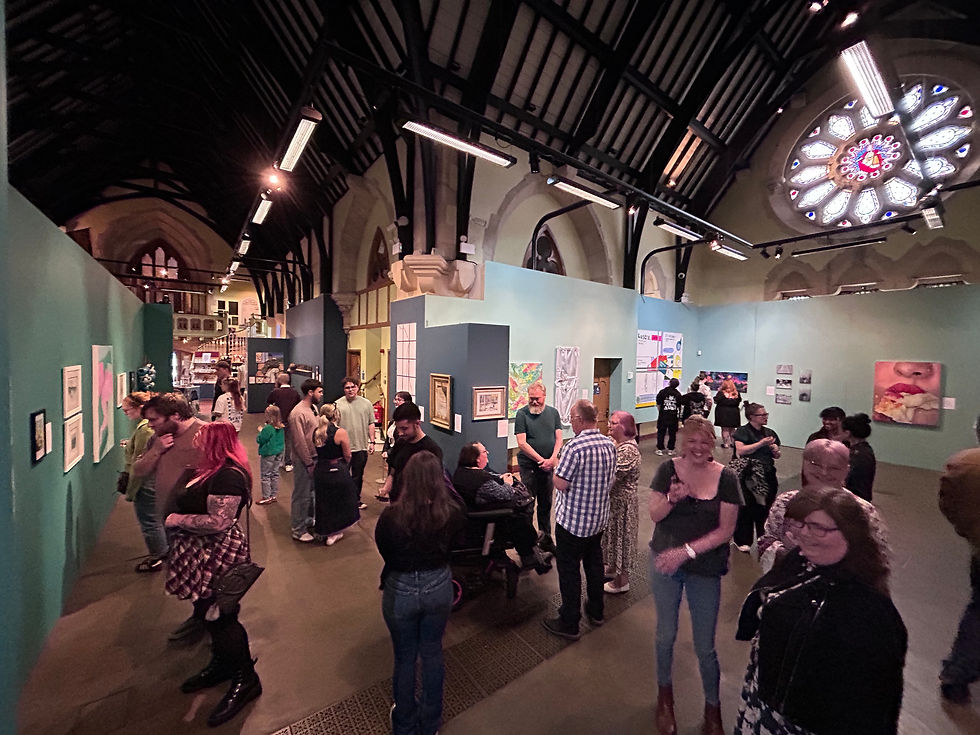
The exhibition opening was a really successful evening, with many visitors engaging with the varied and excellent work on display. It was particularly wonderful to see students exhibiting alongside colleagues, creating a space where staff and students were not separated but connected through multifaceted creative practices. Everyone was at different stages in their journey yet collectively contributing unique responses to a shared theme of resilience.
Resilience runs from the 2nd May – 4th July at Hartlepool Art Gallery.


Comments